Confidently Wrong: What 10,000 AI Answers Reveal About Financial Advice
I use AI every day. It drafts, it summarizes, it researches, and it handles some of that work better than I do. Parts of my own workflow, including the first draft of content like this, run through it. So understand that what follows is not a man yelling at a robot cloud.
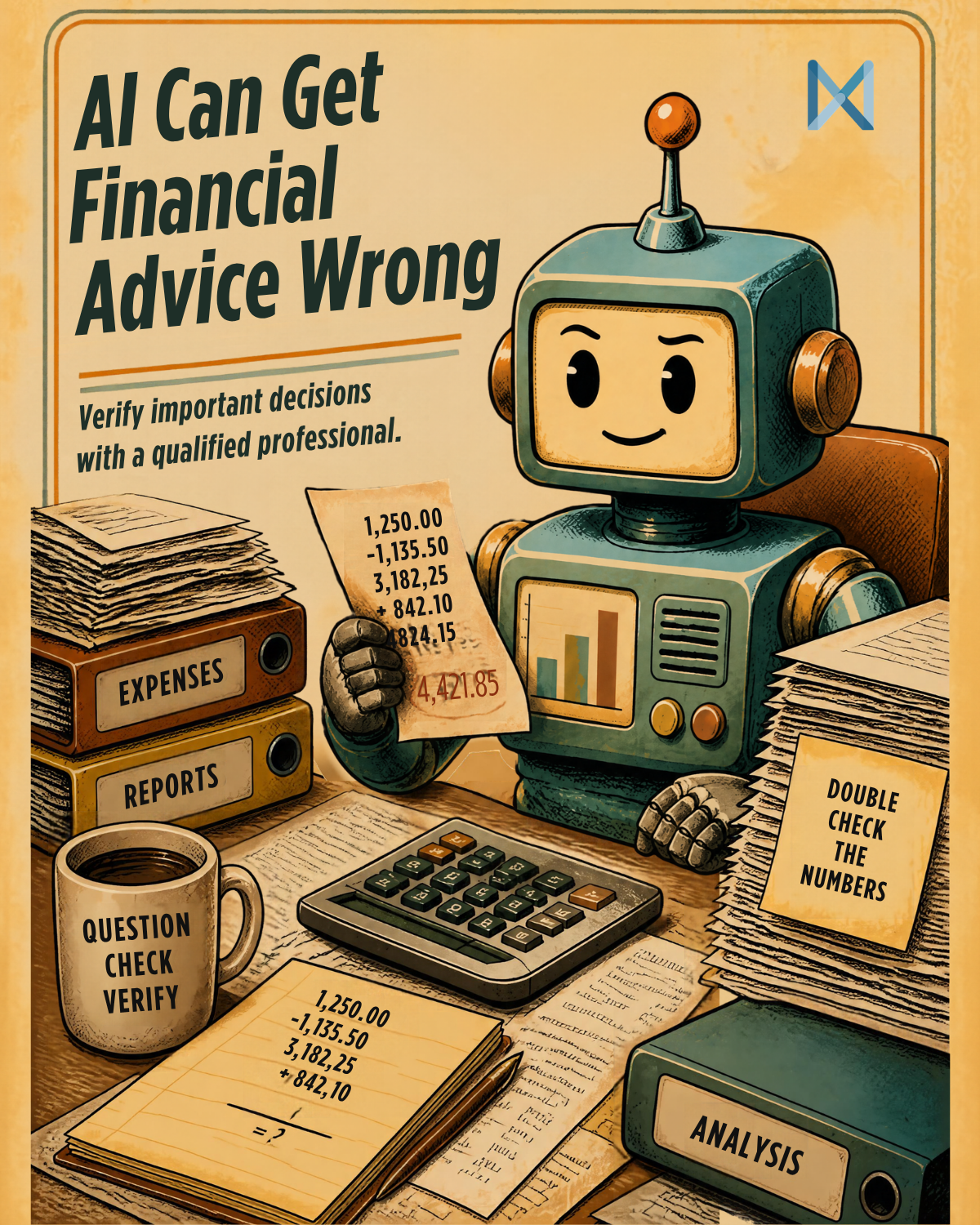
In September, researchers at Saturn, a UK technology firm that works with hundreds of financial advice companies, published a study with a title worth the price of admission: Artificial Authority. They put 121 real money questions to 18 AI models, free and paid versions of ChatGPT, Gemini, Claude, and Copilot among them, ran every question five times, and graded more than 10,000 answers on debt, mortgages, pensions, retirement, and tax.
The models got it wrong 57 percent of the time.
On hard, multi-part tax scenarios, the error rate reached 88 percent. Free versions failed about 63 percent of the time; paid versions still failed about half the time. This is not a fringe behavior problem, either: separate UK regulator research found that roughly a quarter of consumers already trust general-purpose AI with money questions. The mistakes the study found were rarely cartoonish. They were incomplete answers, missing figures and deadlines, outdated rules, and occasionally rules that simply do not exist.
But the finding that should actually change your behavior is not a percentage. The researchers observed that wrong answers arrived in the same fluent, authoritative tone as right ones. The machine does not clear its throat before it invents a tax rule. Confidence is the interface, whether or not the content has earned it.
THE INDUSTRY GOT THERE FIRST
Here is the uncomfortable part for my profession: artificial intelligence did not invent confident, unaccountable financial advice. It learned from the masters.
Financial media has run on the same formula for decades. Predictions delivered in a steady voice, zero follow-up when they miss, and a fresh set of forecasts every January that nobody ever grades. The pundit who was wrong about last year's market is back this year, same chair, same confidence. We have simply automated him, given him a friendlier interface, and removed the commercial breaks.
That is why the fix is not switching chatbots. The fix is changing what you require from advice. Not confidence. Accountability.
THREE QUESTIONS CONFIDENCE CANNOT ANSWER
Whenever advice shows up sounding sure of itself, human or machine, run it through three filters.
Does the source know your whole picture? Your taxes, your insurance, your cash flow, your goals, and the kid who might need a fifth year of college. A chatbot knows your prompt.
Is the source accountable for the outcome? When a fiduciary gives advice, there is a license, a regulator, and a relationship on the line. When a chatbot is wrong, you get an apology shaped like a paragraph.
Is there a system behind the answer? Good financial outcomes rarely come from brilliant answers. They come from boring structure: broad global diversification backed by decades of academic evidence, rebalancing rules that respond to drift instead of headlines, and cash flow with assignments made in advance. This is exactly why we partner with Currence (livecurrence.com), a cash flow platform that captures your income in one central reservoir and routes it by rules you set once, with a human coach involved in setting them. A system does not hallucinate. It just executes.
WHAT AI IS ACTUALLY FOR
Used well, AI is a phenomenal thinking partner for your money. Let it explain a term, summarize a document, or help you build the list of questions you bring to a professional. That last one might be its best use: walk into a meeting with sharper questions than you have ever asked.
Just do not confuse the research assistant with the advisor. The assistant is a tool you check. The advisor is a person you hold to account. One of them is accountable to you. The other one is accountable to nothing, and it will tell you so in a perfectly confident tone.
If you want to pressure-test how the confident voices hold up against the evidence, I teach a free 90 minute class called Dismantling the Myths of Investing; the next session is October 19. And if you would rather talk about your actual picture, book a Discovery Call at discovery.inbundance.com. I promise to say "it depends" at least once, which, it turns out, is what the truth often sounds like.
Corey Kaster, LUTCF is an Investor Coach and founder of Inbundance Wealth Management in Portland, OR
Investing and financial planning involve risk, including the possible loss of principal. You should consult a qualified financial professional before making any financial decisions.